An itinerary through Florence
Discovering the Best of the Italian Renaissance
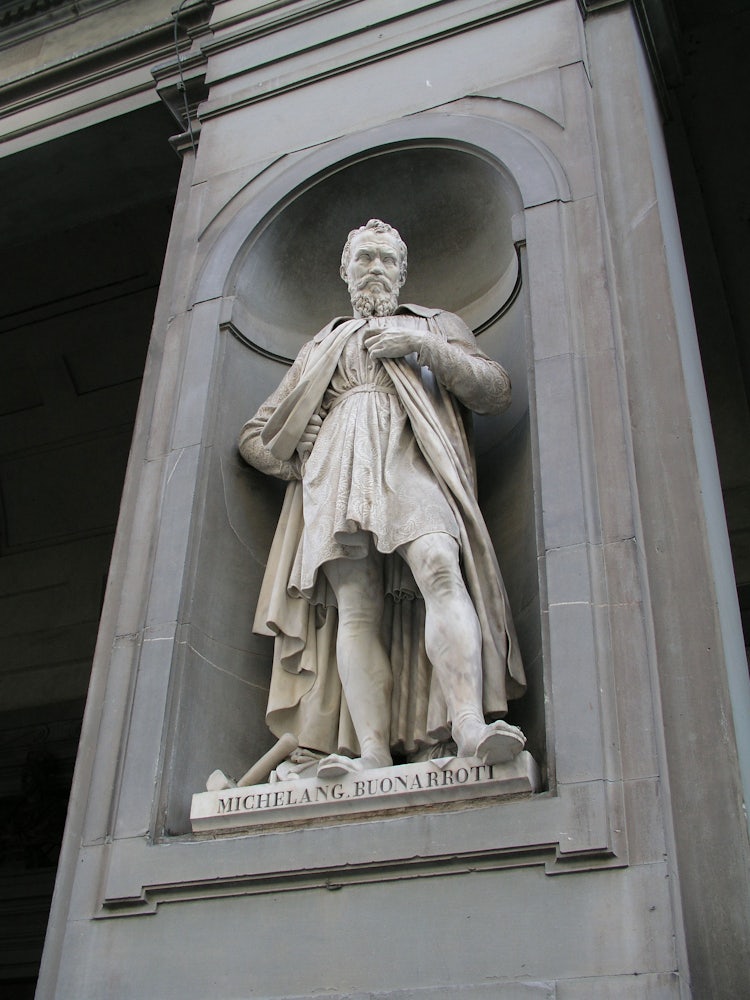
Few artists have left such a deep and enduring mark in art history like the one left by Michelangelo Buonarroti. Born in Tuscany in a small town near Arezzo, above the Casentino valley, near La Verna Michelangelo was quickly whisked off towards Florence and in particular Settignano where due to his mother’s poor health he had a wet nurse. Michelangelo would often tease that he received more than milk from his nurse, absorbing her family’s tradition: stone carving.
Though having spent the majority of his life in Rome, Michelangelo considered himself a Florentine, and it is in Florence where many of the artist's masterpieces are proudly on exhibition. Exploring the city of Michelangelo means retracing the steps of his artistic experience and visiting places inextricably linked to his memory.
The proposed itinerary will show you both some of the most famous works of the great artist and some of the most important monuments of Florence. We suggest you read through this article and use it as a reference as you explore the many wonders of Florence. We hope you have fun identifying as many as possible of these perfect masterpieces by Michelangelo.
Start at CASA BUONARROTI
Did you know?
Michelangelo created some of his most famous works of art, the Pietà in Rome and the David in Florence before he was even 30 years old?! Truly a man born with creative genius in his blood.
To better understand the evolution of Michelangelo Buonarroti’s style, we will first head to Casa Buonarroti, situated in the vibrant and picturesque district of Santa Croce. Despite the name, Casa Buonarroti (House of Buonarroti) is not the place where the artist lived. The palace was built by his beloved nephew, Leonardo, and it passed from one generation to another until the extinction of the family.
It houses two pieces which the great artist sculpted in his twenties - both are in the style of a bas-relief: the Battle of the Centaurs and the Madonna della Scala. The first would not have been possible without the knowledge of the classical statuary which he acquired while studying at the Garden of San Marco as a young teenager (the open air academy sponsored by the Medici family). The second is a clear homage to great sculptor Donatello.
Next stop SANTO SPIRITO
If we are following a chronological itinerary, then we can admire the work of a young Michelangelo at the church of Santo Spirito.
Situated in the popular district of Oltrarno, the church Santo Spirito is one of the most beautiful Renaissance churches in Florence. It is here where Michelangelo, as a young man, found shelter as an artist after the death of his patron Lorenzo de’ Medici, known as the Magnificent, in 1492.
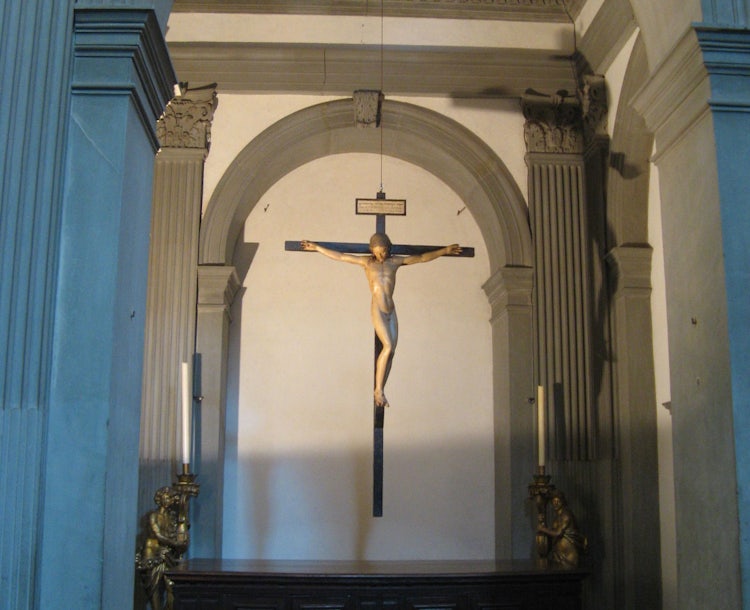
While at Santo Spirito, Michelangelo was granted permission by the Prior to dissect the corpses of the nearby hospital to learn more about the human body and translated it into his artwork. To show his appreciation for this unusual experience, he carved a touching wooden Crucifix in 1493.
The cross is a unique image of Christ as a frail teenage body, most certainly inspired by the many corpses of young men he saw at the hospital. It represents a sad and introspective allegory of human weakness facing death.
Head Over to BARGELLO...
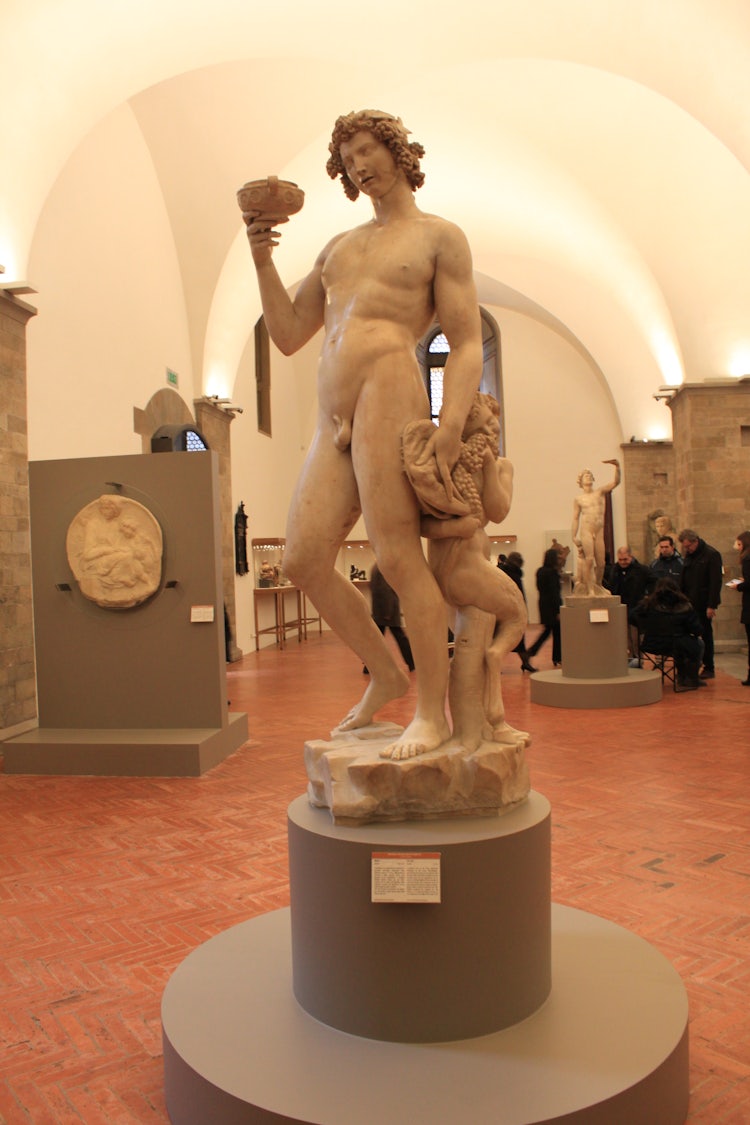
After the riots that forced the Medici family to go into exile in 1494, Michelangelo lost his patrons and moved to Rome. Though perhaps most well known for his frescos at the Vatican, it was in Rome that he sculpted the famous Pietà in St. Peter and the Bacchus now at the Bargello Museum in Florence.
The rooms on the ground floor of this wonderful museum exhibit Tuscan 16th century works, focusing in particular on four masterpieces by Michelangelo (1475-1564) such as the Bacchus and Brutus. Here you will also find the Tondo Pitti (also known as the Madonna and Child). The tondo or round shape was typical of art for the home, and many times wealthy families would have one in their homes.
The fourth piece is David / Apollo. The last piece was created for Baccio Valori, a Medici ally and the Governor of Florence, around 1530 and due to the unfinished status of the marble carving there appears to be some doubt as to who it should present.
...then on to the ACCADEMIA
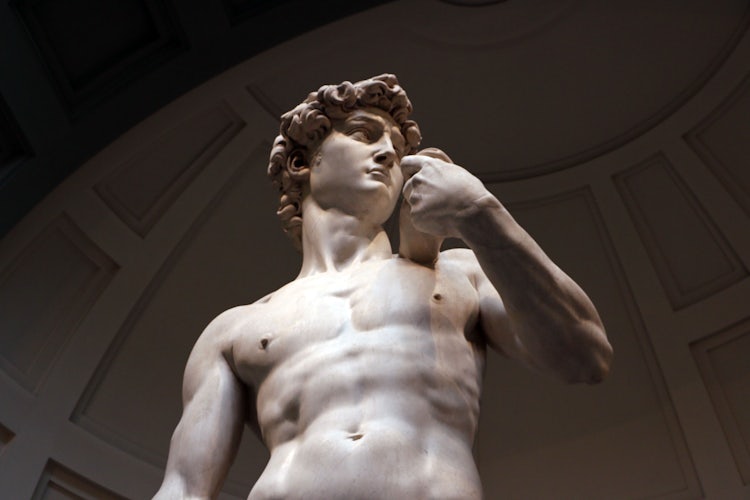
He returned to Florence in 1501, where he created some of his most famous masterpieces, inlcluding the magnificent David, now at the Accademia Gallery. This masterpiece is carved from a block of marble which remained neglected for 25 years, after two attempts at “finding” the Davide inside by previous artists it was finally given to Michelangelo, who at only 26 years of age, convinced the Florentine government to let him finish the work thus leaving us today with an undisputable masterpiece.
“Non-finito” (or Incomplete)
The common theory is that Michelangelo left many sculptures incomplete because he was unsatisfied with the development...though there are some who suggest that a great artist could abandon his work because the idea was more important than the finished results thus he did it on purpose to leave them in an “unfinished” state.
Many other statues by the great artist are displayed at the Accademia. These works are “non-finito” sculptures and the figures appear the be stuck within the marble block, struggling to come out. We will be astonished by the “non finito” statue of St. Matthew, made for the Cathedral of Florence, or the famous Prigioni, a marble group planned for the for the tomb of Pope Julius II in Rome. To learn more about the Prisoners and Michelangelo's style, read this page.
A Change of Styles at the UFFIZI
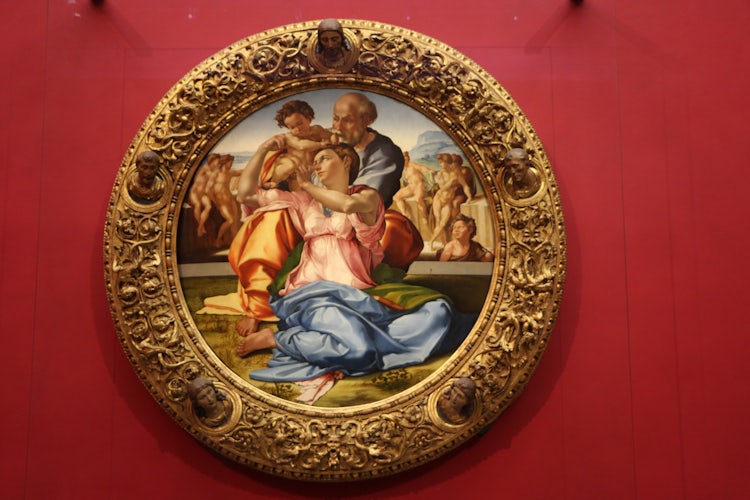
During his stay in Florence between 1501-1504, Michelangelo accomplished another masterpiece: the Tondo Doni, which is displayed today at the Uffizi Art Gallery. Unknown to many, this was his first painting on canvas and the only work of this kind in Florence.
Stop at PALAZZO VECCHIO
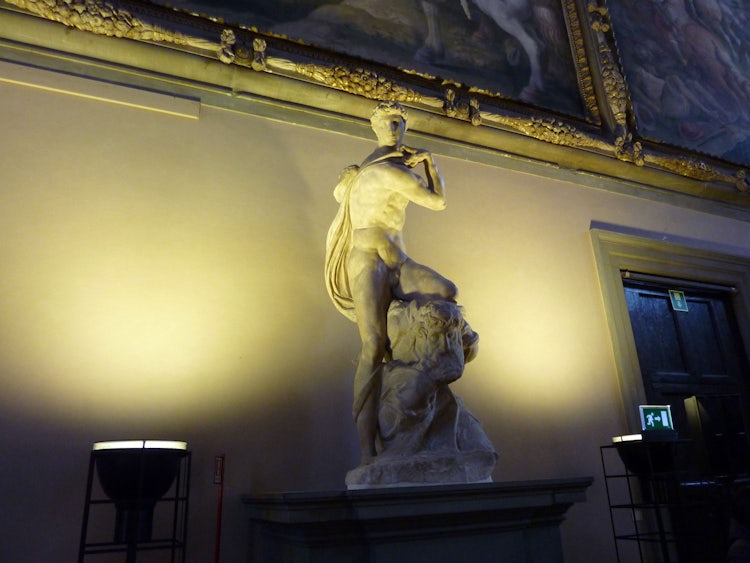
The Genius of Victory is another statue conceived for one of the many versions of the tomb of Pope Julius II in Rome and displayed in the Palazzo Vecchio (or Palazzo della Signoria), inside the magnificent Salone dei Cinquecento.
This statue was placed in Palazzo Vecchio after the death of Michelangelo, when Vasari pressured the artist’s nephew to “gift” it to to Duke Cosimo I de' Medici who used it to symbolize Florence's conquest of Siena.
Walk over to SAN LORENZO
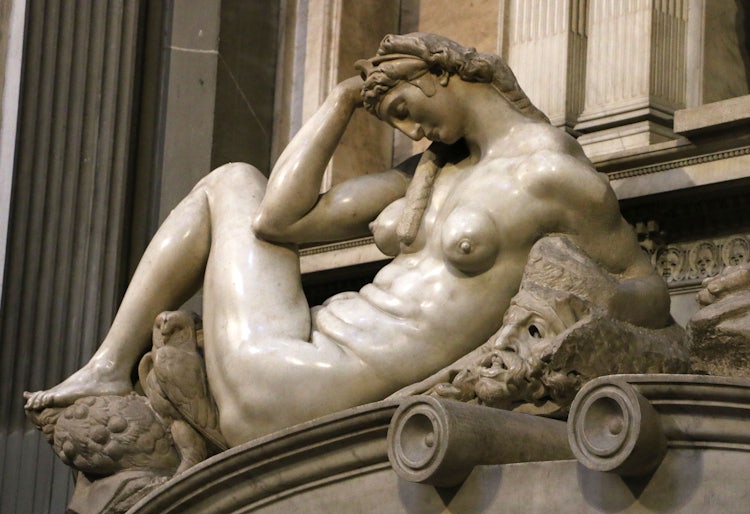
In the meantime, from 1515 to 1534, two members of the Medici family became popes: Leo X and Clement VIII, respectively son and grandson of Lorenzo the Magnificent. The two popes commissioned Michelangelo to build the Sagrestia Nuova in the Medici Chapels and the Laurentian Library for the Basilica of San Lorenzo. These are both excellent examples Michelangelo’s diverse skills, since he was the architect and artist behind both - and even if he left Florence before either was finished both are credited to him. Michelangelo's work showed an innovate use of space which was considered revolutionary for its time.
Though not open to the public, this chuch is home to the "secret room" just to the left of the Sacrestia Nuova where Michelangelo escaped for three months during the last stages of the Spanish seige against Florence. Only 7 meters long and 2 meters wide, in 1530 Michelangelo covered the walls with sketches and designs while he waited out the attack of the city above.
Last stop: OPERA DEL DUOMO
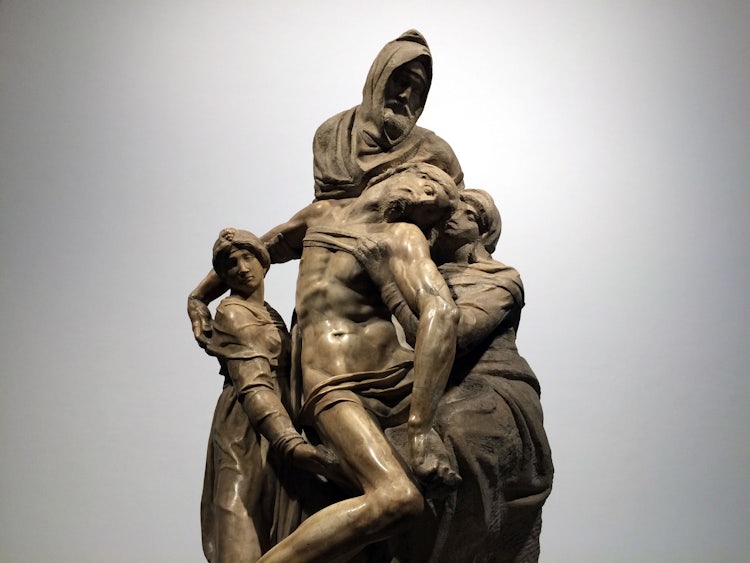
Though Michelangelo’s spirit and genius will forever walk the streets of Florence and be on display throughout the city, for our itinerary this is the last stop. The last work is the dramatic Pietà Bandini, carved in Rome in 1550 to decorate his tomb. It is now housed in the recently restored Museo dell'Opera del Duomo. This sculpture is one of the most interesting masterpiece by the great master displayed in the Tuscan capital. The pathos of the composition is palpable. What adds a special significance to this work is the self-portrait of Michelangelo in the likeness of Nicodemus, the male figure holding the lifeless body of Christ flanked by Mary and Magdalene.
The tour ends therefore at Piazza del Duomo. To learn more about the historical events behind the works mentioned above, you can read the biography of Michelangelo Buonarroti. The in-depth article provides further details about the long and troubled life of this unique genius.